Warning Signs of Dangerous Electrical Wiring That Every Florida Homeowner Must Recognize
Thousands of homes across The Villages, Lady Lake, Wildwood, and surrounding Central Florida communities were built decades ago with electrical wiring that met the standards of its time. Those standards are long obsolete. The wiring that powered a home with a single television and a handful of light fixtures was never designed to handle today’s HVAC systems, smart home devices, kitchen appliances, and electric vehicle chargers.
The danger is that failing wiring rarely announces itself with a dramatic event. It deteriorates silently behind walls, inside attics, and beneath floors. By the time visible symptoms appear, the risk has often been building for years. Recognizing these warning signs early and calling a licensed electrician immediately is the most effective way to protect your home and your family.
Flickering and Dimming Lights That Will Not Stop
Occasional flickering during a thunderstorm is normal in Florida. Persistent flickering or dimming, especially when you turn on an appliance like an air conditioner, a microwave, or a hair dryer, is not. This symptom usually indicates that your circuits are overloaded, your wiring connections have loosened over time, or your electrical panel cannot distribute power efficiently.
In homes throughout The Villages and Sumter County, this is one of the most commonly reported electrical complaints. It is also one of the most commonly dismissed. Homeowners assume it is minor. A licensed electrician understands that it frequently signals deeper wiring degradation that requires professional diagnosis.
Why Ignoring Flickering Lights Is Genuinely Risky
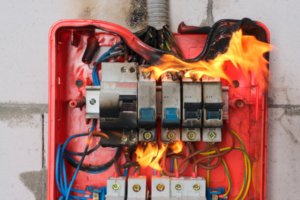
Loose connections generate heat. Heat degrades wire insulation. Degraded insulation exposes bare conductors. Exposed conductors arc. Arcing starts fires. That chain of events can unfold entirely out of sight inside your wall cavities. What starts as a minor annoyance can become a catastrophic house fire without any additional external warning.
Warm or Discolored Outlets and Switch Plates
Touch your outlet covers and switch plates periodically. If any feel warm to the touch, or if you notice brown, yellow, or scorch marks on the plastic faceplate, you are looking at evidence of excessive heat being generated behind that cover. This heat typically comes from loose connections, damaged wiring, or an overloaded circuit feeding that outlet.
This is never a cosmetic issue. It is a direct indicator of a fire hazard that demands immediate attention from a licensed and insured electrician.
A Persistent Burning Smell With No Visible Source
If you detect a faint burning odor, similar to hot plastic or singed rubber, and cannot trace it to a cooking appliance or another obvious source, your electrical wiring may be overheating inside the walls. This is one of the most urgent warning signs on this list.
Do not attempt to investigate behind walls or inside your electrical panel. Contact a licensed electrician immediately. In The Villages and the surrounding areas, JJ Electricians offers 24/7 emergency electrical service for exactly this type of situation.
What Causes That Burning Smell
Overloaded circuits force more current through wires than they were designed to carry. The excess current generates heat that melts wire insulation, scorches surrounding materials, and can ignite wood framing or attic insulation. Cloth-insulated wiring and aluminum wiring, both common in older Florida homes, are especially vulnerable to this type of failure.
Breakers That Trip Repeatedly
A circuit breaker that trips once is doing its job. A breaker that trips repeatedly is telling you something is wrong with the circuit it protects. Common causes include too many appliances drawing power from a single circuit, a short circuit caused by damaged wiring, or a ground fault in a moisture-prone area like a bathroom or kitchen.
Resetting the breaker repeatedly without identifying the root cause is not a solution. It is a gamble. Every time that breaker trips and is reset, the underlying fault remains and potentially worsens. A professional electrical inspection identifies the exact cause and provides a permanent, code-compliant repair.
Two-Prong Ungrounded Outlets Throughout the Home
If your home still has two-prong outlets, your wiring system lacks a ground path. Grounding is a fundamental safety feature that directs stray electrical current safely into the earth rather than through your body or your appliances. Homes built before the mid 1960s commonly lack grounded circuits.
Replacing two-prong outlets with three-prong outlets without rewiring the underlying circuit does not add grounding. It creates a false sense of security. Only a licensed electrician can properly install grounded wiring that provides genuine protection.
Buzzing, Crackling, or Sizzling Sounds
Electricity, when flowing through properly installed and maintained wiring, is silent. If you hear buzzing from an outlet, crackling behind a wall, or sizzling from your electrical panel, current is arcing across a gap it should not be crossing. Arcing generates extreme heat in a very localized area and is a leading cause of electrical fires in residential properties.
These sounds require immediate professional evaluation. Do not wait to see if the sound stops on its own.