What Actually Happens Inside Your Walls When a Circuit Overloads
Most homeowners have experienced a tripped breaker. The power goes out in one section of the house, you go to the panel, flip the breaker back, and move on. It seems minor. An inconvenience at most. But that tripped breaker is telling you something important about what just happened inside your walls, and the story it tells is more serious than most people realize.
A circuit overload is not just a switch flipping off. It is heat building inside a wire, connections straining, and insulation approaching its limits. Understanding the process that occurs between the moment a circuit overloads and the moment the breaker trips helps homeowners appreciate why overloads should not be treated casually.
How a Circuit Normally Works
Under normal conditions, electricity flows through wiring at a current level the wire can safely handle. A 15-amp circuit carries up to 15 amps. A 20-amp circuit carries up to 20. The wire size is matched to the circuit rating because different wire gauges can safely carry different amounts of current.
When the load stays within the rated capacity, the wire generates minimal heat and everything functions normally.
What Happens When the Load Exceeds Capacity
The moment the current flowing through a wire exceeds its rated capacity, physics takes over.
Heat Generation Begins
Electrical resistance in the wire converts excess current into heat. The more the current exceeds the wire’s rating, the more heat is generated. This heat occurs along the entire length of the wire, not just at one point.
Heat Concentrates at Weak Points
While heat builds along the full wire length, it concentrates at connection points, where wire meets terminal screws, wire nuts, or outlet contacts. These connections have slightly higher resistance than the wire itself, which means they generate disproportionate heat.
Insulation Temperature Rises
The wire insulation absorbs the heat from the conductor. As temperature rises, the insulation approaches its maximum rated temperature. If the overload continues long enough, the insulation reaches temperatures where it begins to soften, discolor, and eventually break down.
The Breaker’s Job and Its Limitations
The circuit breaker is designed to detect overcurrent and disconnect the circuit before damage occurs. It does this by sensing the heat or magnetic effect of excessive current and tripping open.
Breakers Are Not Instantaneous
A breaker rated for 20 amps does not trip the instant current reaches 20.1 amps. Breakers have a time-current curve. They tolerate mild overloads for extended periods and trip quickly only under severe overloads. This means moderate overloads can persist for minutes, generating sustained heat before the breaker finally trips.
Repeated Moderate Overloads Cause Cumulative Damage
A circuit that repeatedly overloads at 125% of capacity may trip after several minutes each time. During those minutes, heat damage accumulates in the wire insulation and connections. Over hundreds of cycles, this cumulative damage weakens the system in ways that are invisible until failure occurs.
What Happens When Breakers Fail to Trip
Breakers can fail. Older breakers, corroded breakers, or improperly sized breakers may not trip when they should. When this happens, the overload continues unchecked.
Sustained Heat Degrades Insulation
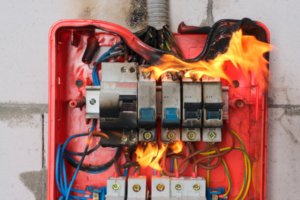
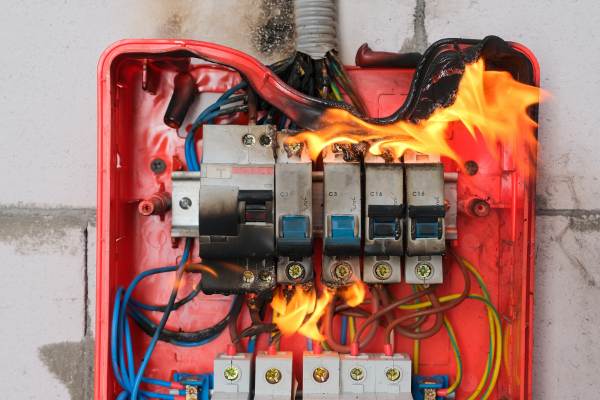
Without the breaker interrupting the circuit, heat continues to build. Insulation softens, melts, and eventually exposes bare conductors.
Exposed Conductors Can Arc
When insulation fails and bare conductors come close to grounded metal, another conductor, or combustible material, electrical arcing can occur. Arcs generate temperatures exceeding 10,000 degrees Fahrenheit.
Combustible Materials Ignite
Arcs and sustained heat in proximity to wood framing, insulation material, or accumulated dust can ignite fires inside wall cavities. These fires can burn undetected until they breach the wall surface.
Why This Matters for Older Homes
Homes in The Villages and surrounding communities often have electrical systems that were designed for lighter loads. As homeowners add appliances, devices, and technology, the load on existing circuits increases. Each addition brings the circuit closer to its limit.
Connections Loosen Over Time
Years of thermal cycling (heating when loaded, cooling when idle) cause terminal screws and wire nuts to loosen gradually. Loose connections increase resistance, which increases heat, which accelerates the problem.
Wire Insulation Ages
Older wiring insulation is more vulnerable to heat damage because it has already endured decades of thermal stress. The margin between safe operation and failure is narrower.
How to Prevent the Hidden Danger
The most effective prevention is ensuring that no circuit is routinely loaded beyond its safe capacity.
Professional Load Assessment
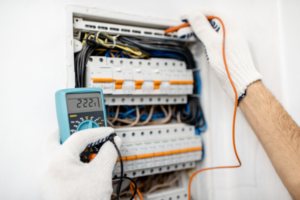
A licensed electrician can measure the actual load on every circuit in your home and identify those that are operating near or above their safe limit. This data guides decisions about adding circuits or redistributing loads.
Adding Circuits Where Needed
Rather than running more devices on existing circuits, adding new circuits from the panel distributes the load safely. This eliminates the chronic overloading that causes cumulative damage.
Panel Upgrades for Modern Demands
If the panel lacks space for additional circuits, a panel upgrade provides the capacity needed to wire the home correctly for today’s electrical demands.
Respect What You Cannot See
A tripped breaker is not an annoyance to reset and forget. It is evidence that dangerous heat built inside your walls. The breaker did its job this time. But the conditions that caused the overload remain, and repeated overloads weaken the system progressively. Understanding what happens inside those walls transforms a tripped breaker from a minor inconvenience into a clear signal that your electrical system needs professional attention.