Why Professional Ceiling Fan Installation Matters More Than Most Homeowners Realize In The Village
Ceiling fans are among the most practical upgrades a homeowner in The Villages can make. They reduce air conditioning costs by creating a wind chill that lets you raise your thermostat several degrees. They circulate air to eliminate stagnant humidity. They add style and comfort to every room they occupy. But the installation process involves far more complexity and risk than most homeowners understand.
A ceiling fan is not a light fixture. It is a heavy, rotating appliance that generates dynamic forces on the junction box, mounting bracket, and ceiling structure every moment it operates. Improper installation creates genuine safety hazards that can result in a fan falling from the ceiling, electrical fires from overloaded circuits, or shock risks from incorrect wiring. Here is what professional installation addresses that shortcuts miss entirely.
The Weight and Motion Problem Most Homeowners Overlook
Standard Light Fixture Boxes Cannot Support Fans
A standard octagonal junction box used for light fixtures is rated for a static load of approximately 6 pounds. A ceiling fan weighs 25 to 50 pounds and generates additional dynamic force from blade rotation that can exceed 100 pounds of torque stress at the mounting point. Installing a fan on a standard light box means the box can pull free from the ceiling joist, sending the running fan crashing down.
Fan-Rated Boxes and Bracing Systems
Professional installation uses fan-rated junction boxes specifically designed to support dynamic loads. These boxes either mount directly to ceiling joists with proper hardware or use expandable metal braces that span between joists and distribute the load. A licensed electrician verifies or installs proper ceiling support before mounting any fan.
Ceiling Structure Assessment
Older homes in The Villages may have ceiling joists with inadequate spacing, weak fasteners, or moisture damage that compromises structural integrity. A professional assessment before installation identifies any reinforcement needed to safely support a fan for years of continuous operation.
Electrical Considerations for Ceiling Fan Installation
Circuit Capacity Verification
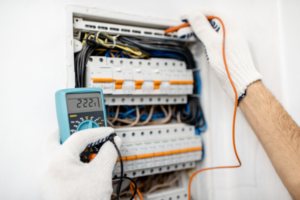
Adding a ceiling fan (especially models with integrated light kits and heating elements) increases the electrical load on the circuit serving that room. If the circuit already supplies multiple outlets, lighting, and other devices, adding a fan may push it toward overload conditions. Professional electrical installation includes verifying available circuit capacity.
Proper Wiring for Independent Fan and Light Control
Most homeowners want separate control of the fan motor and the light kit. This requires either a dual-switch configuration with separate wiring from the switch location to the fan box, or a smart switch/remote system that controls both functions through a single wire run. Your electrician determines the best approach based on your existing wiring and switch locations.
Balancing and Vibration Elimination
An improperly balanced ceiling fan vibrates, wobbles, and generates noise that makes it unusable at higher speeds. Professional installation includes blade balancing, hardware torquing to proper specifications, and verification of smooth operation across all speed settings. A fan that wobbles is not just annoying; the vibration loosens mounting hardware over time, creating a progressive safety risk.
Choosing the Right Fan for Each Room
Sizing for Room Dimensions
A fan too small for the room moves insufficient air. A fan too large overwhelms the space and creates uncomfortable wind force. Professional recommendations match blade span to room square footage: 29 to 36 inch fans for rooms up to 75 square feet, 36 to 42 inch for 76 to 144 square feet, 44 to 50 inch for 144 to 225 square feet, and 52 to 60 inch for larger rooms.
Mounting Height and Blade Clearance
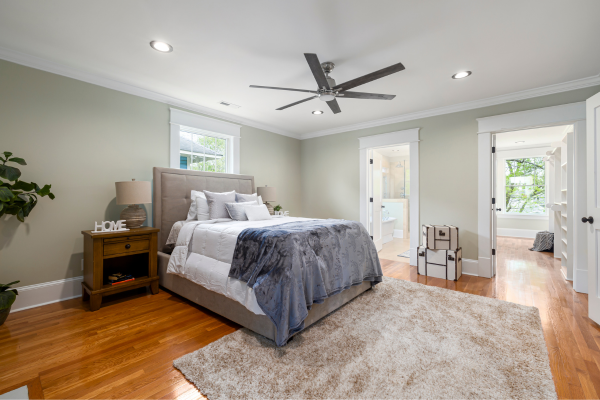
Florida building code requires a minimum ceiling fan blade height of 7 feet above the floor. For standard 8-foot ceilings, this often requires flush-mount or hugger-style fans rather than downrod-mounted models. Professional installation ensures proper clearance for both safety and optimal air circulation.
Outdoor-Rated Fans for Lanais and Covered Patios
The Villages’ outdoor living spaces benefit enormously from ceiling fans, but outdoor installations require UL-rated damp or wet location fans with moisture-resistant motors and blade materials. Using indoor-rated fans in covered outdoor spaces leads to rapid corrosion and motor failure in Florida’s humidity.